
I recently added a second server in OVH France to my homelab setup.
This post is partly documentation, partly a personal note to my future self on why I did this — because at this point, my homelab isn’t just for tinkering anymore. I rely on it for communication, dev environments, personal tools, backups, and a few services I actually use day to day.
At some point, a single box at home just isn’t enough.
Why add another server?
Three simple reasons:
Having backups on the same physical location isn’t really a backup.
If something goes wrong at home (hardware failure, power issues, ISP problems, accidental deletes), I want my data and configs to still exist somewhere else. The OVH server acts as my offsite backup target for:
- Encrypted backups
- Snapshots
- Service data
- Configs
It gives me peace of mind that a single incident won’t wipe everything out.
Some services I run are things I actually use daily (Matrix/Element, Vaultwarden, dev tools, monitoring). I don’t need enterprise-grade HA, but I also don’t want everything to die when one machine is down.
The OVH node gives me:
- A secondary place to restore services
- A fallback environment if my main server is offline
- A way to test recovery instead of just hoping backups work
This forces me to design my setup in a way that can be rebuilt elsewhere — which is healthy discipline.
My compute needs have been creeping up:
- More self-hosted services
- AI / ML experiments
- Dev sandboxes
- Long-running jobs
- Background workers
Instead of overloading one machine, the OVH server lets me offload heavier workloads, experiment more freely, and separate “stable stuff” from “things I might break.”
This is also my MVP justification for eventually adding more capacity as my needs grow.
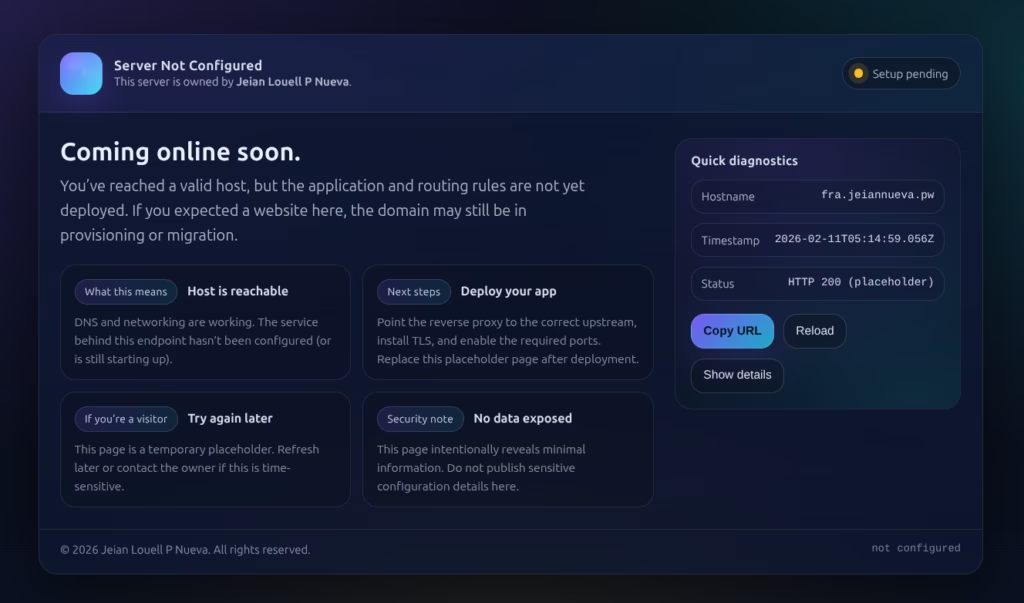
How I think about this setup
I don’t treat this as “two identical servers.”
It’s more like:
- Primary: home server (main services, daily use)
- Secondary: OVH France (backup target + recovery + extra compute)
Some services may never run live on OVH. Some might.
The important part is: I can recover and rebuild if I have to.
Geographic separation alone already removes a big chunk of risk.
What this changes for me
This setup pushes me to be more intentional:
- Backups that can actually be restored
- Configs that are reproducible
- Services that aren’t “snowflakes” tied to one machine
- Fewer “I hope this works” moments
If I can’t restore something on the OVH server, then my backup strategy isn’t good enough yet.
What’s next
This is still evolving. Over time I want to:
- Automate backup validation
- Periodically test full restores
- Define which services are “critical” vs “nice to have”
- Improve monitoring across both servers
- Document my recovery steps properly
This isn’t about building an enterprise system at home.
It’s about not being reckless with systems I already depend on.
Leave a Reply