
PLDT rolled out its 1Gbps fiber plan speed promo for just an additional 500 pesos. Upon the get-go, I knew it was time to reassess my network strategy. Having spent years optimizing my home infrastructure for businesses and multi-user demand, I saw an opportunity for a more resilient, scalable network. Inside our humble home, users like me juggle multiple activities such as school, work and some business. Taking advantage of this promo promise both advantages and challenges.
Why 1Gbps?

Before making the jump, I was managing a dual-provider setup: Globe handling 70% of my traffic and PLDT covering the remaining 30%. This redundancy was key, but I often found peak-hour slowdowns and CDN routing inefficiencies limiting my performance. With PLDT offering a full 1Gbps plan, I had to consider whether the potential speed benefits would outweigh its well-known routing inconsistencies.
For a power user like me, 1Gbps isn’t just about download speed—it’s about ensuring seamless multi-device connectivity, reducing latency, and optimizing network efficiency. Whether I’m running cloud-based services, managing a business remotely, or ensuring my studies and work from home set-up have a residential but enterprise-grade alike internet, bandwidth capacity is a crucial factor.
Did you really make use of the 1GB?
Yes, but there are caveats. I need to ensure my existing network and configuration is efficient. This started with 2 main activities that I typically do whenever there is a significant change within my network configuration.
1. Eliminating Bottlenecks
With great speed comes great responsibility—or at least, the need for proper infrastructure. I ensured that my network backbone could actually support 1Gbps without internal bottlenecks:
- Core Router Upgrade – My UniFi Cloud Gateway Ultra ensures there’s no processing lag when handling 1Gbps traffic.
- Switching Infrastructure – My Linksys managed switches, which already support gigabit speeds, were optimized for VLAN traffic and QoS settings. I have even used 802.1p internally to ensure local and internet quality are in their maximum.
- Wi-Fi Access Points – While I’ve relied on UniFi AC-LR APs for years, I’m eyeing Wi-Fi 7 solutions for high-density environments, especially that the next steps is to move higher than gigabit in the next upcoming years.
2. Rethinking Network Traffic Allocation
Initially, I had strict traffic shaping policies to balance my Globe and PLDT lines. However, with the full 1Gbps upgrade, I’ve relaxed most of these policies and transitioning more data to PLDT rather than the other way around, only enforcing limits for guest devices:
- EDNS Optimization – Ensuring streaming platforms like Netflix and YouTube route to the correct local CDN, minimizing buffering and improving load times.
- Load Balancing Adjustments – While I still retain my Globe fiber as a secondary provider, PLDT now takes the lead for high-bandwidth tasks.
- No Artificial Traffic Shaping – Unlike before, I no longer restrict per-device limits except for guest access, allowing seamless bandwidth consumption for work, entertainment, and smart home applications.
Other challenges
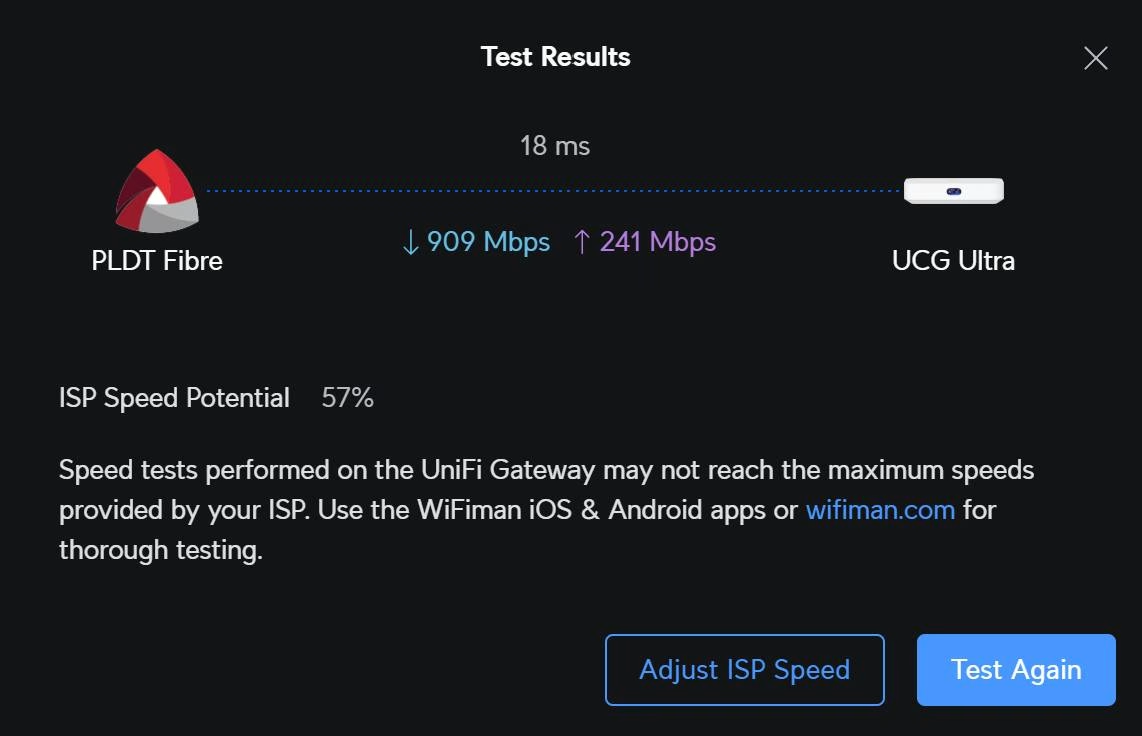
Despite its impressive speeds, PLDT’s 1Gbps plan comes with its share of challenges. The most frustrating issue? Routing inefficiencies. I’ve encountered multiple instances where large file downloads from international servers performed poorly on PLDT, forcing me to switch back to Globe. It’s not always about speed—sometimes, it’s about how well the ISP handles network paths.
While PLDT excels in domestic and Southeast Asian data routes, I’ve found that connections to regions like India and Oceania—critical for my work—are often unreliable. I haven’t conducted a full test suite across multiple regions yet, but I’ve noticed asymmetric speeds, where downloads hit 1Gbps, and uploads are capped at around 500Mbps. This disparity can create bottlenecks in cloud-based operations, making it necessary to adjust my workflow accordingly.
Downtime has also been a recurring pain point but these are outside PLDT’s control. Contractors and line breaks are still at risks when running a single provider. While I mitigate this with a redundant provider, it’s clear that relying solely on just one provider would be risky.
Is It really worth It?
From my perspective, the answer is: It depends on your use case.
For casual users, the sheer speed may seem excessive and running dual-internet provider is not common in typical households. PLDT can function as a sole provider, and with its bundled landline service, it presents a strong value proposition today. I urge my readers to think about the need need to look beyond just the speed and the short-term benefits. The real challenge begins when promotional pricing expires and routing efficiency, forcing a reassessment of cost versus value.
To summarize: Upgrading to 1Gbps isn’t just about speed, for me it’s about ensuring my network is future-proof. It requires a well-structured infrastructure, intelligent traffic management, and strategic redundancy planning. In the digital age, raw bandwidth alone doesn’t define success—resilience, adaptability, and smart network design do.
Leave a Reply